Qvera DICOM Router (QDR)
DICOM router: route, transform and archive medical images
Native DIMSE and DICOMweb, and DICOM files of any size, on-premise or in your own cloud.
Licensing starts at $9,980 a year. See pricing

Qvera DICOM Router (QDR)
Native DIMSE and DICOMweb, and DICOM files of any size, on-premise or in your own cloud.
Licensing starts at $9,980 a year. See pricing
The Qvera DICOM Router (QDR) is a healthcare integration engine for medical imaging. It receives DICOM from modalities, PACS, VNAs and archives, applies routing and transformation rules you define, and delivers the result wherever it needs to go — another archive, a cloud imaging service, a research platform, or an HL7 or FHIR feed for the clinical side.
A DICOM router sits between the systems that produce images and the systems that store, read and act on them. It decides where each study goes, based on what is in the study itself. QDR is powered by the Qvera Interface Engine (QIE), which Qvera has developed since 2008. The model is the same: a channel receives a message, condition nodes decide where it goes, mapping nodes change what it contains, and destination nodes deliver it. Rules are written in JavaScript with a built-in Code Wizard.
It runs at production scale on a single server, and it handles DICOM files of any size. Both are covered below.
The Qvera DICOM Router implements DICOM network communication directly. No gateway product sits in front of it, and nothing extra has to be installed to process DICOM.
Over DIMSE, QDR is both a service class provider (SCP) and a service class user (SCU): it listens for inbound associations as an SCP and initiates outbound ones as an SCU.
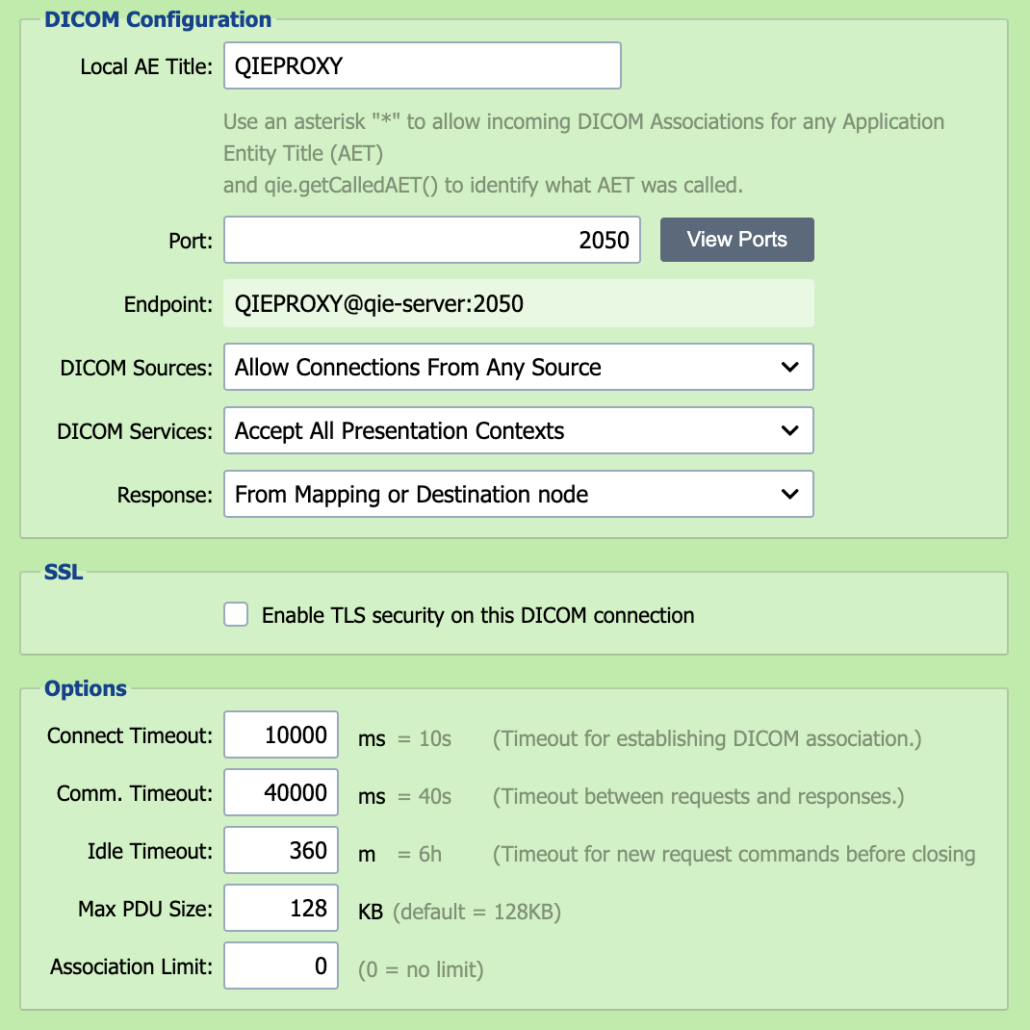
A channel source configured as a DICOM listener.
Over DICOMweb, QDR supports the full set of web services:
Both directions support TLS, including mutual authentication, using QDR’s own certificate store.
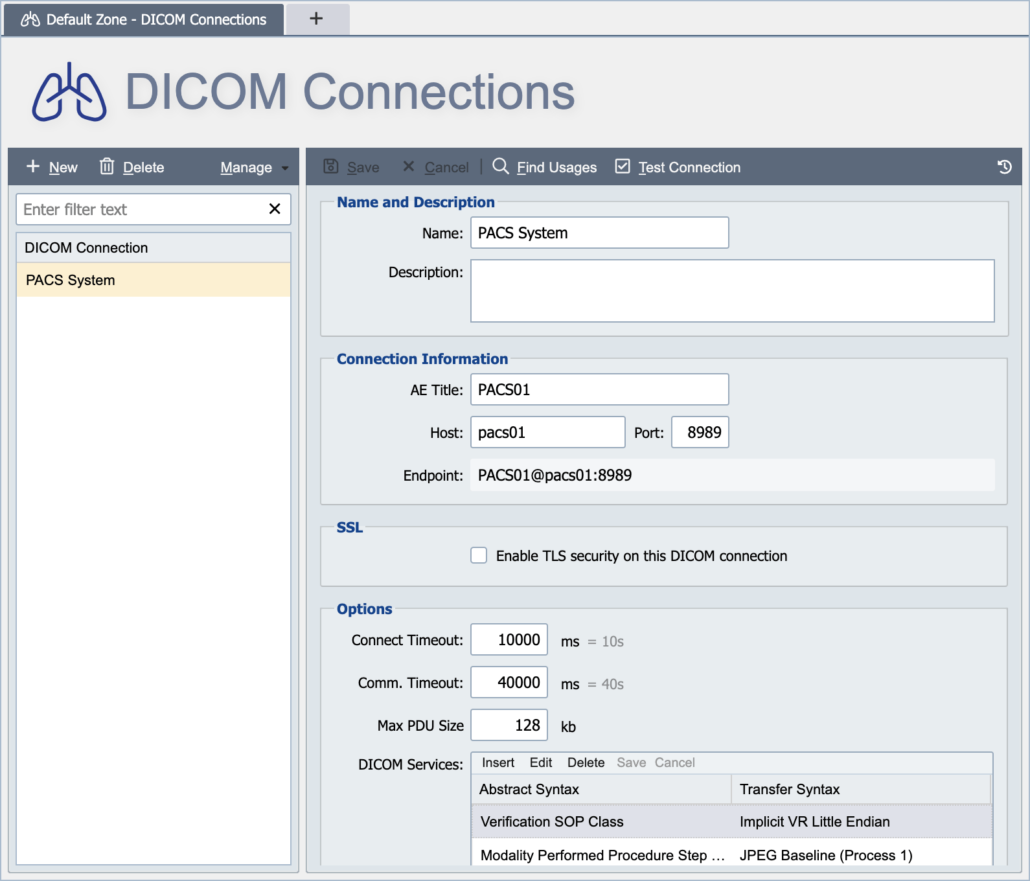
A DICOM connection, down to the negotiated transfer syntaxes.
Routing is scripted, so it is not limited to what is inside the study. A condition node is JavaScript: it can match on a DICOM attribute, look a value up in a database, call an external service, combine several tests with your own Boolean logic, or apply whatever rule the workflow actually needs.
For the common case there is no code to write. Any DICOM attribute is addressable by group and element — 0010,0020 for patient ID, 0008,0060 for modality — with wildcards and predicates such as contains, starts with, ends with and equals. You build the rule in the editor, and it generates the script for you.
One message can fan out to several destinations at once: send the study to the archive, a copy to a research platform, and an HL7 ORU to the electronic health record.
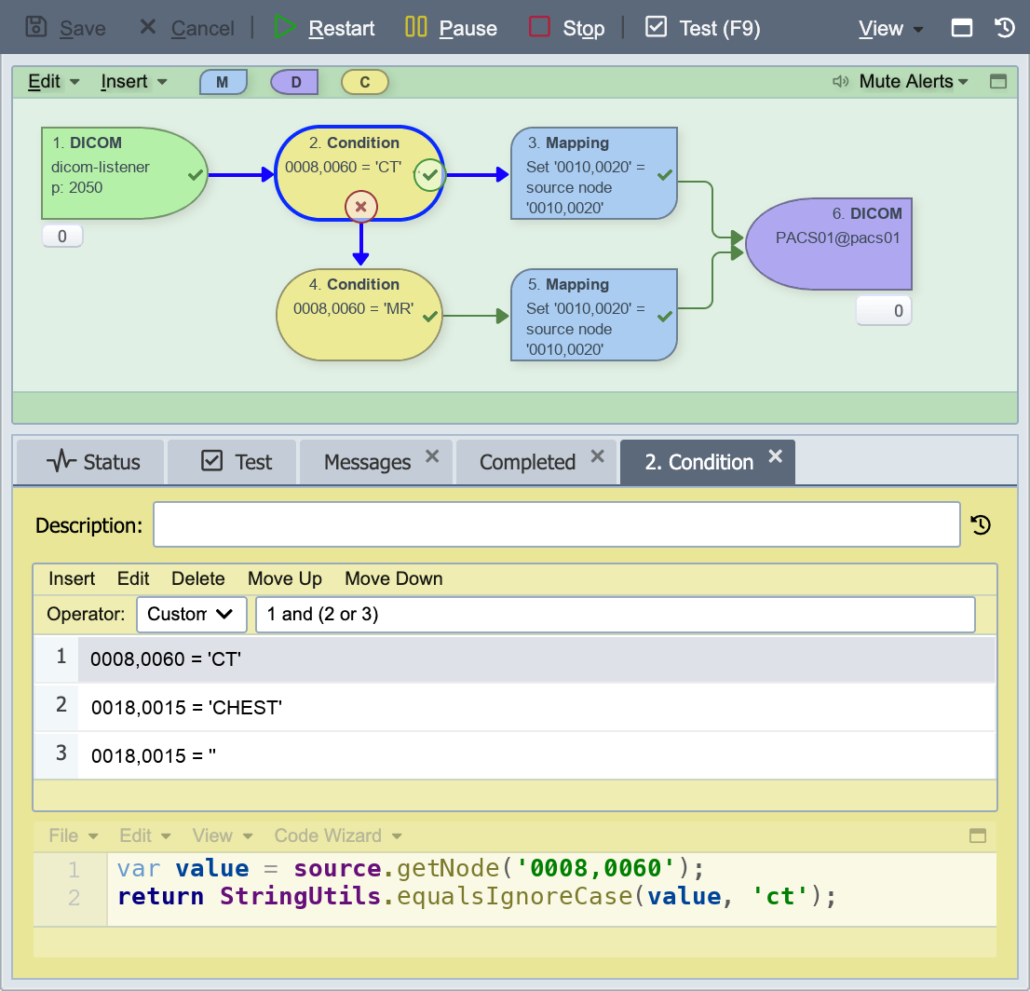
Routing DICOM studies on modality, and the script behind the rule.
Transformation is tag-level and complete. Mapping nodes read and write every DICOM value representation, operate on whole groups and sequences, merge instances, and change transfer syntax. Private tags resolve through the private creator, and vendor private-tag keywords — including Siemens and Philips tags — display by name rather than as raw hex.
Two capabilities worth naming:
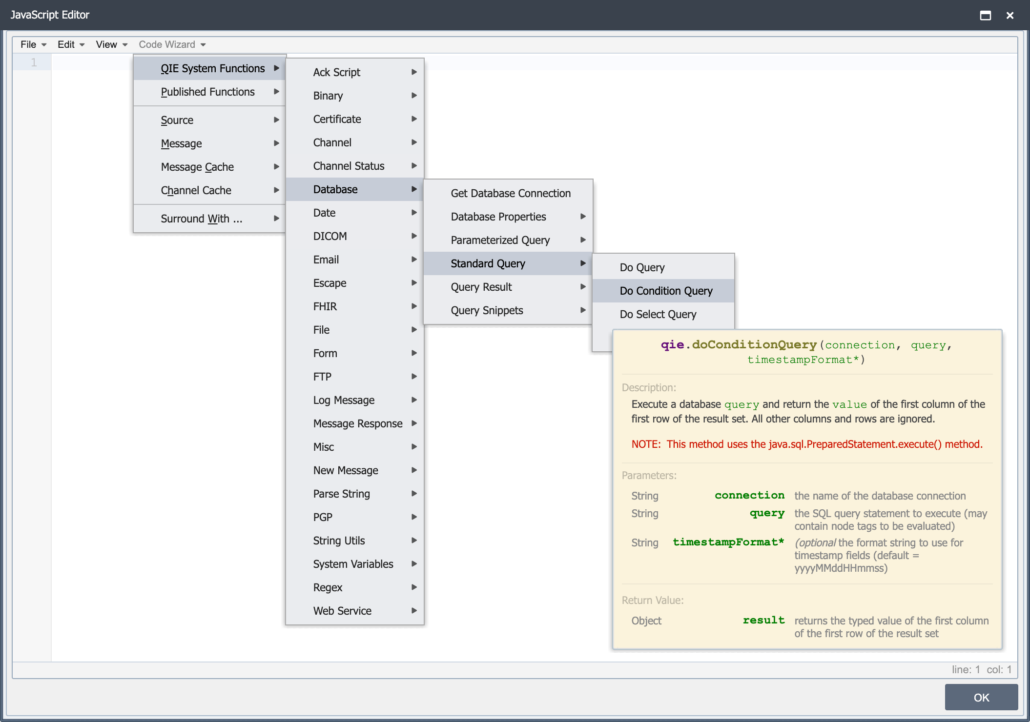
The Code Wizard, with DICOM among the built-in function families.
One production instance handles more than 6 million DICOM messages on an average weekday, and has passed 8.4 million in a single day. These are not lightweight metadata records: every one is a full DICOM file carrying image pixel data, and the files are large.
File size is not the limit either. Because pixel data never has to pass through memory, DICOM files of any size — whole-slide imaging, tomosynthesis, gigabyte-plus cine runs — are received, routed and delivered, with the pixel data streamed encrypted to separate storage and reattached on output. Throughput and file size scale independently: a large study does not consume the headroom that message volume needs.
When one server is not enough, nodes share a single database behind a load balancer and the cluster grows horizontally.
Yes, and that is the point.
Many organizations run one tool for clinical messaging and a second for imaging: two products, two license models, two skill sets, two vendors to call. The Qvera DICOM Router is the same engine as the Qvera Interface Engine, configured for imaging. Not a companion product, not an imaging edition — the same engine, so anything it does for DICOM it also does for HL7 v2 and v3, FHIR, X12, NCPDP, ASTM, CDA and IHE profiles, over MLLP, REST, SFTP, file, database, message queue and network share.
The licensing model is the proof. Qvera offers Channel-based, Enterprise, and OEM licensing models for QIE and QDR. There is no DICOM module, no imaging tier and no per-study charge. An imaging interface and a clinical interface use the same product capabilities.
So a hospital that buys QDR to solve an imaging problem already owns the engine for the clinical side, and a team that learns one of them has learned both.
Three connection types cover the imaging environment:
Beyond those, QDR writes to AWS and Azure storage in Qvera-validated configurations used in production today. Deployment itself is unconstrained: on-premise, in containers, or in your own AWS, Azure or Google Cloud account.
QDR runs on-premise, in containers, or in your own cloud on AWS, Azure or Google Cloud. It is the same engine and the same console wherever it runs, and it stores its data in Microsoft SQL Server, MySQL or MariaDB.
There is no proprietary datastore, so backups, monitoring and access control follow the practices your database team already has. The database can run on your own servers or as a managed cloud service, including Amazon RDS, Amazon Aurora and Azure Database for MySQL.
For containers, Qvera publishes official images on Docker Hub and Amazon ECR, ready for Kubernetes or Docker Compose, and nodes can be added to or removed from a running cluster. High availability is available on every licensing model: two or more nodes share one database behind a load balancer, with DICOM listener ports in the pool, and if one becomes unavailable, another takes over its processing automatically.
The documentation covers each path step by step: the Install Guide for Windows and Linux servers, the Container Guide for Kubernetes and Docker, the AWS ECS Install Guide, and High Availability for clustering.
Running QDR at more than one site, or inside customer networks you do not control, is what the Remote Management Hub is for: one console for monitoring and controlling engines that sit inside separate networks, over outbound-only connections with no per-site VPN.
DICOM traffic runs over TLS in both directions, with mutual authentication where the peer supports it, using certificates managed inside QDR.
For data leaving the imaging environment, QDR de-identifies at the tag level. A default de-identification table — the DICOM tags that are normally removed — imports in one click, and each tag can be cleared, hashed, replaced with a new UID, or transformed deterministically so linkage survives. The original values can be encrypted into the message itself and restored later by the holder of the private key — de-identification that is reversible for the people entitled to reverse it, and not for anyone else.
Qvera’s own controls are attested under SOC 2 Type 2. For the attestation and how to request the report, see the Qvera security and compliance page.
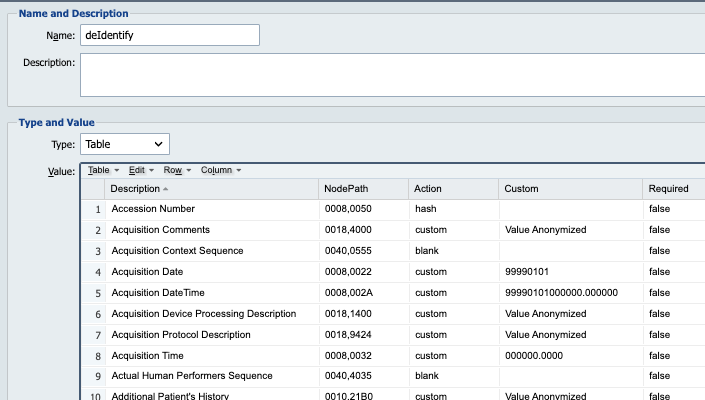
The de-identification table.
Teams evaluating an imaging router are usually trying to avoid being locked in. QDR is a commercial product, and these are the places that normally matter:
Pricing. Qvera offers Channel-based, Enterprise, and OEM licensing models for QIE and QDR. Channel-based licensing starts at $9,980 per year for 2 channels. View Qvera Licensing and Pricing.
QIE and QDR are in production at more than 600 sites, running more than 25,000 interfaces and processing more than 50 million messages a day. Qvera has built healthcare interface engine software since 2008 and is SOC 2 Type 2 attested.